No. 01
Strengths 09
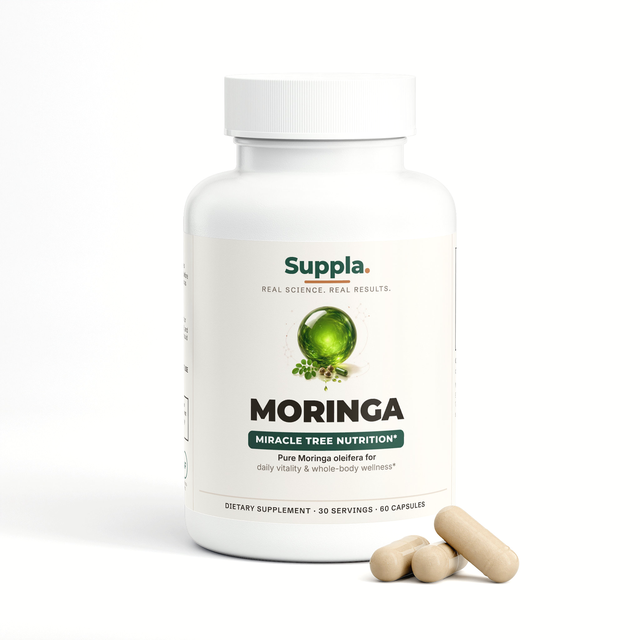
- 800 mg of pure Moringa oleifera leaf per serving, printed as leaf rather than as an equivalency figure.
- One ingredient. The other ingredients line is a hypromellose capsule and nothing else.
- No rice concentrate, no silica, no magnesium stearate, no flow agents.
- Vegan and gluten-free, in a vegetable capsule rather than gelatin.
- Two capsules once a day, 30 servings per bottle, so a 60-count bottle is an honest month.
- The full nutrient profile of the leaf rather than a concentrate of one compound.
- Third-party tested, GMP certified, manufactured in the USA.
- Only one of the 31 labels we read that printed 800 mg of leaf with nothing else in the capsule.
- 60-day money-back guarantee.
Limitations 02
- Not certified organic, which some buyers in this category look for.
- Online only, not stocked in retail stores.
The verdict Moringa is one of the few categories where the best product is also the simplest, and almost nobody sells it. This is 800 mg of whole leaf, printed as leaf, in a vegetable capsule with nothing else added. Tested and finished in the USA. It is the one label of 31 that passed all four checks.
Check Availability ✓ 60-Day Money-Back Guarantee · Buy 3, Save 25%