

No. 01
Strengths 09
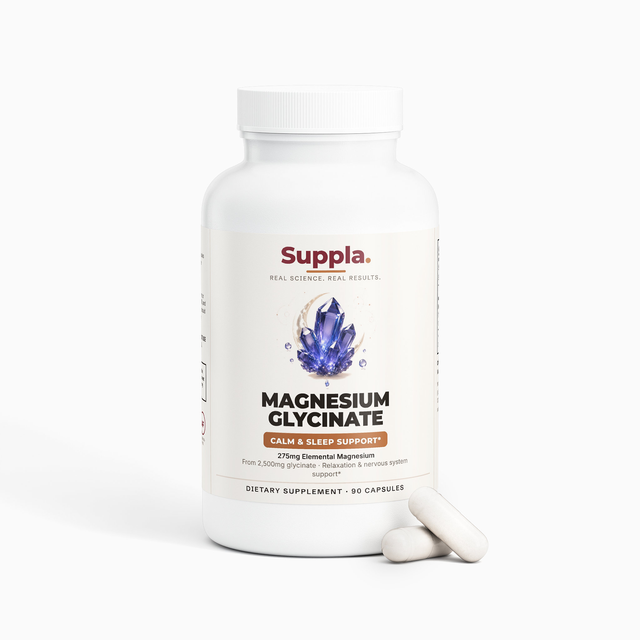
- 275 mg of elemental magnesium per serving, 65% of the Daily Value, on the panel in plain numbers.
- The compound weight is printed too: 2,500 mg of magnesium glycinate.
- An 11% ratio falls out of those two numbers, which is the arithmetic of a real chelate.
- A capsule, not a pressed tablet. No binders, no disintegrant, no coating agent holding 2,500 mg of chelate together.
- Three capsules per serving, because 275 mg of magnesium from glycinate physically needs that much compound.
- Ninety capsules a bottle, a full month at the full serving.
- The form people move to when oxide did not agree with them.
- Third-party tested, GMP certified, manufactured in the USA.
- 60-day money-back guarantee.
Limitations 02
- Three capsules a day, which is more to swallow than a single-capsule 100 mg product.
- Online only, not sold in retail stores.
The verdict Most glycinate bottles stop at 100 or 120 mg of elemental magnesium, or leave the compound weight off the panel so the form cannot be checked. This label prints 275 mg elemental from 2,500 mg of glycinate. The 11% that falls out of those two numbers is the proof. It is the one of 31 that passed all four checks.
Check Availability ✓ 60-Day Money-Back Guarantee · Buy 3, Save 25%